Lifeline Survivor Benefit: Emergency Phone and Internet Support
The Safe Connections Act created temporary Lifeline support for qualifying survivors who attempt to separate a mobile line from an abuser’s shared account. The benefit can reduce the cost of phone, internet, or bundled service for up to six months.
Independent article. FreePhonesWireless.org is not the FCC, USAC, a phone company, a law-enforcement agency, or a survivor-service organization.
The direct answer
The Lifeline Survivor Benefit is a temporary communications discount, not a guaranteed free phone.
Qualifying survivors can receive up to $9.25 per month toward phone, internet, or bundled service for as long as six months. Qualifying survivors on Tribal lands may receive enhanced support of up to $34.25 per month.
The survivor must provide proof of an attempted mobile line separation and meet either ordinary Lifeline eligibility or the broader financial-hardship rules created for survivors.
Once approved, the survivor enrolls with a participating Lifeline company. That company controls the service plan, network, SIM, eSIM, bring-your-own-device option, phone inventory, fees, upgrades, and replacements.
The line separation comes first
The phone company’s acknowledgement of an attempted line separation is required for emergency survivor support.
Survivor rules are broader than standard Lifeline
The temporary benefit adds a 200% income route, WIC, school meal programs, CEP enrollment, and current-year Pell Grant eligibility.
The support lasts no more than six months
Changing phone or internet companies does not create a new six-month period.
Standard Lifeline may continue afterward
After emergency support ends, a survivor who meets ordinary Lifeline rules can apply for the standard benefit.
Two connected processes
Separating the mobile line and applying for Lifeline are different actions.
The phone company handles the shared-account line request. USAC determines eligibility for emergency Lifeline support. One does not automatically complete the other.
Request separation from the mobile phone company
A survivor on a shared mobile contract can ask the company to separate the survivor’s line and eligible connected lines. Review the FCC line-separation guide before beginning.
Save the acknowledgement
The company must respond within two business days. Its email, text message, or letter becomes proof that the line-separation request was attempted.
Apply separately for the Lifeline Survivor Benefit
The National Verifier reviews the line-separation proof and the survivor’s program or income qualification.
Enroll with a participating provider
Approval does not activate service automatically. The survivor must select a participating phone or internet company.
What the temporary benefit provides
Emergency support, expanded eligibility, and a path to independent service.
The survivor benefit is designed to preserve affordable communications during a transition. It is not a cash payment, legal remedy, or promise of a particular phone.
Temporary Lifeline support
The benefit can continue for up to six months from the beginning of emergency support.
Phone, internet, or bundled service
Unlike ordinary voice-only Lifeline, the survivor benefit can provide up to $9.25 toward qualifying phone service during the emergency period.
Enhanced support may apply
A qualifying survivor living on qualifying Tribal lands may receive up to $34.25 monthly during the emergency period.
Who can qualify?
A survivor may use ordinary Lifeline rules or additional Safe Connections Act hardship routes.
The program covers eligible adults against whom a covered act was committed or allegedly committed, as well as certain adults caring for a person affected by a covered act.
The survivor or a child or dependent can participate in the qualifying program.
Participation in the Special Supplemental Nutrition Program for Women, Infants, and Children can qualify for emergency support.
This includes participation through a Community Eligibility Provision school or school district.
A survivor or qualifying dependent receiving a Pell Grant in the current award year can use this route.
This temporary survivor threshold is higher than the 135% limit used for ordinary Lifeline income eligibility.
BIA General Assistance, qualifying Head Start, Tribal TANF, and FDPIR may establish eligibility.
2026 survivor income threshold
The emergency benefit allows household income up to 200% of the Federal Poverty Guidelines.
Household size is based on people who live together and share income and expenses. These limits apply to the survivor-specific emergency route.
| Household size | 48 states, D.C. and territories | Alaska | Hawaii |
|---|---|---|---|
| 1 person | $31,920 | $39,900 | $36,720 |
| 2 people | $43,280 | $54,100 | $49,780 |
| 3 people | $54,640 | $68,300 | $62,840 |
| 4 people | $66,000 | $82,500 | $75,900 |
| Each additional person | Add $11,000 | Add $13,760 | Add $13,060 |
Acceptable proof may include a prior tax return, pay stubs or other income records covering three consecutive months, or an official benefits statement. The document should identify the survivor or dependent, show income, and contain a recent issue date.
Documents and safer communication
The required proof is narrow, but the contact and storage choices deserve care.
Use a device, email account, phone number, mailing address, or contact method that is safer for the survivor’s circumstances whenever possible.
Line-separation acknowledgement
The email, text, or letter must show the survivor’s name, the phone company’s name, and a date within the previous 12 months.
Program or income proof when requested
A program document should show the participant, program, issuing agency, and current date. Income proof should show the person, income amount, and recent issue date.
Choose a preferred contact method
The application allows contact preferences such as email, mail, phone, or text. Select an option that does not expose sensitive application activity.
Protect saved notices and account access
Consider where screenshots, downloaded letters, browser history, passwords, shared cloud storage, and message previews may be visible before storing application records.
How to apply
The survivor application is available online or by mail.
A survivor who lacks the line-separation acknowledgement can apply for ordinary Lifeline first, then reapply under survivor status after receiving the required notice.
Obtain proof of the attempted line separation
Save the phone company’s acknowledgement. It must identify the survivor, the company, and a date within the last 12 months.
Start through the official survivor page
Use the official Lifeline Survivor Benefit page and choose the survivor application route.
Upload or mail requested documents
Online applicants can upload copies. Paper applicants can mail the application and supporting documents to the Lifeline Support Center address listed on the official form.
Select a participating company after approval
Use the Companies Near Me tool and verify that the company can apply the survivor benefit to the chosen phone, internet, or bundled service.
What happens during the six months?
The temporary benefit includes a midpoint eligibility check and an end-of-period decision.
Survivors who qualified only through the expanded Safe Connections Act rules may need to show that they can transition to ordinary Lifeline eligibility.
Emergency service starts with the selected provider
The approved discount is applied to qualifying service. Any phone, SIM, activation, upgrade, or other device term comes from the company.
Continued eligibility may be reviewed
A survivor who originally qualified through standard Lifeline rules does not need this extra process. A survivor using only expanded SCA criteria may receive instructions from USAC.
Standard Lifeline requires ordinary eligibility
A qualifying survivor may apply for standard support of up to $9.25 for internet or bundled service or up to $5.25 for voice-only phone service.
Choosing the provider offer
Independent service should also be practical, private, and affordable after the emergency period.
Compare coverage, account controls, number transfer, device security, monthly limits, and the price that may apply after temporary support ends.
Ask whose name controls the new account
Confirm account ownership, authorized users, billing access, password recovery, PIN protection, number-transfer controls, and whether notices can be hidden from a prior account.
Verify coverage and plan limits
Check service at important locations, high-speed data, hotspot use, international calling, extra-data costs, and the price after the emergency benefit ends.
Do not assume a free phone is included
The provider may offer a phone, SIM, eSIM, BYOD activation, or paid upgrade. Confirm whether a pictured model is guaranteed and whether it is new or refurbished.
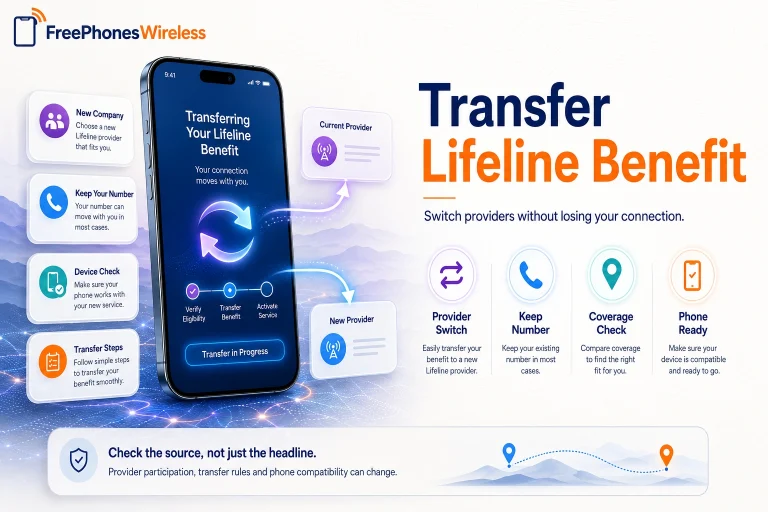
A provider transfer does not restart the six months
The survivor benefit can continue with a new participating company only through the original emergency-support period.
Lifeline Survivor Benefit FAQ
Direct answers about line separation, hardship rules, documents, privacy, and service.
These answers focus on the temporary emergency benefit rather than repeating ordinary Lifeline rules.
Who is the Lifeline Survivor Benefit for?
It is for qualifying adults affected by domestic violence, human trafficking, or other covered acts, including certain adults caring for a person affected by a covered act.
Is a police report or court order required?
The Lifeline survivor application requires proof of an attempted mobile line separation from the phone company. The acknowledgement must show the survivor’s name, the company’s name, and a date within the previous 12 months.
How quickly must the phone company answer a line-separation request?
The phone company must respond within two business days with an email, text message, or letter acknowledging the request.
Can a survivor qualify through WIC or a Pell Grant?
Yes. WIC, free or reduced-price school meals, CEP school enrollment, and a Federal Pell Grant in the current award year are additional survivor-specific qualification routes.
What is the 2026 income limit?
The survivor-specific emergency route allows household income at or below 200% of the 2026 Federal Poverty Guidelines. For one person in the contiguous states, D.C., and territories, the limit is $31,920.
Does the benefit provide a free phone?
Not automatically. It discounts qualifying service. A participating company decides whether it includes a phone, SIM, eSIM, BYOD service, or paid upgrade.
Can a survivor change phone or internet companies?
Yes. The remaining survivor benefit may transfer to another participating company, but the original six-month period does not restart.
What happens when the six months end?
A survivor who meets ordinary Lifeline eligibility can apply for standard support. The standard benefit may provide up to $9.25 for qualifying internet or bundled service or up to $5.25 for voice-only phone service.
Where should a survivor apply?
Start with the official Survivor Benefit page. The application is available online and by mail.
The practical conclusion
Separate the line, protect the proof, apply through the official survivor route, and plan for month six.
The Lifeline Survivor Benefit can create a temporary path to independent communications. The strongest application keeps the phone-company request, Lifeline eligibility, contact preferences, and provider service terms clearly separated.
Official references: Lifeline Survivor Benefit rules, documents and application, 2026 survivor income limits, FCC line-separation guidance, standard Lifeline eligibility, and participating companies. Provider participation, networks, plans, device inventory, fees, and application procedures can change.