California LifeLine Free Government Phone: Benefits, Eligibility and How to Apply
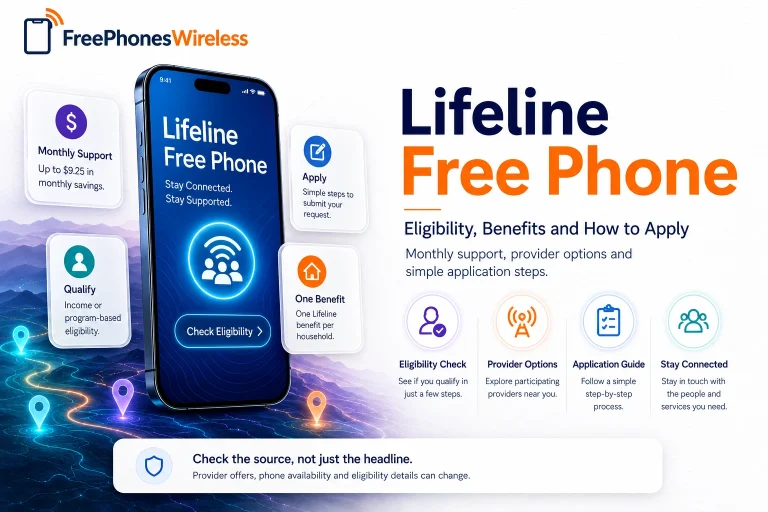
California LifeLine is a state program that discounts qualifying home or cell phone service. A participating wireless company may also offer a free phone, SIM, eSIM, or discounted upgrade, but the state benefit itself does not promise a particular device.
Independent article. FreePhonesWireless.org is not the CPUC, FCC, California LifeLine Administrator, or a phone company.
The direct answer
California LifeLine can lower the cost of phone service, and some providers may include a phone.
California LifeLine is administered by the California Public Utilities Commission. It provides qualifying households with a discount on either home phone or cell phone service at the household’s primary residence.
The current state subsidy is up to $19 per month. Eligible customers who also complete the separate federal Lifeline enrollment may receive up to another $9.25 per month, for a combined subsidy of up to $28.25 in many cases.
A wireless provider may market its plan as a California LifeLine free phone offer, but the phone comes from that company or its vendor. Approval does not guarantee an iPhone, 5G phone, new device, or exact model.
It is a California state program
California LifeLine is separate from the federal Lifeline program, even though eligible households may use both discounts on qualifying service.
The phone company starts the application
Applicants contact an authorized provider first. The provider submits the enrollment request and explains the available plan and device route.
State and federal enrollment are now separate
New customers seeking both discounts must complete both enrollment processes. Existing combined-benefit customers renew separately when their renewal period arrives.
One household benefit still applies
A household generally chooses one discounted home phone or cell phone service and cannot collect California LifeLine discounts from multiple companies.
What the program can provide
The benefit is broader than a phone giveaway headline.
California LifeLine reduces qualifying service costs. The amount reaching a customer’s bill depends on the service type, approved provider plan, and whether federal Lifeline is also active.
Up to $19 per month
The state benefit may discount qualifying monthly home phone or cell phone service.
Up to $28.25 with federal Lifeline
Most eligible subscribers who enroll in both programs may combine up to $19 from California and $9.25 federally.
Connection or conversion discounts
Eligible home phone services may receive a service connection discount or conversion discount of up to $39.
Some surcharges and taxes are waived
California LifeLine service may be exempt from specified program surcharges, fees, and phone-service taxes.
The discount can be used for either a home phone or a cell phone, not both, unless a limited exception applies for eligible TTY users or participants in the Deaf and Disabled Telecommunications Program.
The 2026 enrollment change
Two benefits can support one plan, but they now travel through separate application tracks.
Beginning February 1, 2026, California LifeLine and federal Lifeline no longer use one shared eligibility process for new enrollments.
Start with an authorized provider.
The provider checks whether it offers California LifeLine in your area, explains the plan, and submits the state enrollment request.
Complete California LifeLine eligibility.
Use a qualifying public assistance program or the current California household income limits, and provide the requested copies of documentation.
Complete federal Lifeline separately.
Customers seeking the additional federal discount must also complete the federal process. Our Lifeline Free Phone article explains the federal eligibility and application system.
Confirm both discounts on the account.
Approval for one program does not automatically prove approval for the other. Check the provider account and notices to confirm which benefits are active.
Program-based eligibility
A benefit received by someone in the household may establish eligibility.
California LifeLine recognizes several programs that are not always highlighted in general federal Lifeline summaries, including WIC, LIHEAP, and the National School Lunch Program.
Documentation is required
The application may request a program identification card, eligibility notice, decision letter, benefit statement, or another official record. Submit copies rather than original documents.
The California LifeLine Administrator makes the eligibility decision. A phone company cannot promise approval before that process is complete.
2026 California LifeLine income limits
Income-based qualification uses California’s own annual limits.
The limits below are effective from June 1, 2026 through May 31, 2027. Household gross income means income before taxes from household members and applicable sources.
| Household size | Maximum annual gross income |
|---|---|
| 1 person | $24,600 |
| 2 people | $33,300 |
| 3 people | $42,100 |
| 4 people | $50,800 |
| Each additional person | Add $8,700 |
Income documentation may include a prior tax return, three consecutive months of recent paycheck stubs, benefit statements, pension records, unemployment records, child-support documents, or other official proof accepted by the program.
How to apply for California LifeLine
Choose the company before completing the state application.
California LifeLine does not begin with a random “free phone” form. The official process begins through an authorized service provider.
Search providers by location
Use the official California LifeLine provider search and compare companies serving your area.
Ask for the California LifeLine plan
Confirm the monthly price, data, hotspot use, underlying network, phone or SIM route, shipping, activation, taxes, and replacement policy.
Let the provider start enrollment
The authorized company submits the enrollment request. California permits only one active wireless enrollment request at a time.
Complete the state form by its deadline
Apply online or return the signed form with copies of the required identity and eligibility records. Missing information or a late form can cause denial.
Apply separately for federal Lifeline
Complete the federal eligibility process when seeking the additional federal discount, then confirm both benefits with the provider.
Will you receive a free phone?
The plan can be discounted even when the phone is not included.
California LifeLine funds qualifying service. Wireless providers decide whether enrollment includes a basic smartphone, a 5G model, a SIM, eSIM, BYOD activation, or a paid upgrade.
A free phone may come from available inventory
Unless the written offer names the model, expect the device to vary. It may be new or refurbished and may not support 5G.
BYOD may preserve a better device
An unlocked compatible phone may provide better cameras, storage, battery life, accessibility, or 5G capability than a basic enrollment device.
An iPhone or flagship is not a state benefit
For realistic Apple device routes, refurbished checks, and misleading model claims, read our Free Government iPhone article.
How to compare providers
The most generous phone photo does not prove the strongest service.
Compare the actual plan at your address, then evaluate the device offer. Provider availability and phone inventory can differ by ZIP code.
Coverage and underlying network
Check home, work, school, medical locations, and common travel routes rather than relying only on a statewide coverage claim.
Monthly high-speed data
Ask what happens after the included high-speed allowance is used and whether data stops, slows, or requires a purchase.
Hotspot and international features
Hotspot data, Mexico or Canada calling, international texting, and voicemail features vary by company and plan.
Phone condition and replacement rules
Confirm whether the phone is new or refurbished and who pays when it is lost, stolen, damaged, defective, or needs a new battery.
Shipping, activation, and optional charges
Look for checkout costs, taxes, extra data, upgrades, accessories, insurance, and fees that are not covered by the monthly benefit.
A special California phone program
Eligible foster youth have a separate, more specific phone route.
California operates a dedicated LifeLine Foster Youth Program for qualifying current and former foster youth rather than requiring them to use the ordinary household application structure.
Who may qualify
The current official program is for current or former foster youth or non-minor dependents ages 13 through 20 who were in California foster care at any time on or after their 13th birthday.
The official program page currently lists a Motorola Moto G Power 5G phone, charger, protective case, unlimited talk and text, up to 25 GB of high-speed data, and up to 10 GB of hotspot data.
Review the official California LifeLine Foster Youth Program for current eligibility, enrollment, device, and service details.
Current or former foster youth and eligible non-minor dependents.
Phone, charger, and protective case are listed by the official program.
The current offer also lists up to 25 GB of high-speed data.
Verify current plan and network details during enrollment.
Renewal and account rules
Approval is not permanent, and deadlines matter.
California LifeLine participants renew annually. Missing the state renewal or a separate federal renewal can reduce or end the discounts.
Watch for the annual renewal
California LifeLine sends renewal information around the participant’s anniversary date. The CPUC describes the mailed renewal form as arriving in a pink envelope.
Renew state and federal benefits separately
Customers receiving both discounts may need to complete two separate renewals when their renewal period arrives.
Respond by the date on the form
An incomplete, unsigned, unsupported, or late application or renewal may be denied. Keep copies of submissions and notices.
Understand the 30-day enrollment freeze
After a wireless enrollment request begins, another request with a different provider may be blocked until a final decision, cancellation, or the end of the 30-day period.
California LifeLine FAQ
Direct answers to common California free-phone questions.
These answers distinguish the state discount, federal support, provider phone offers, and the special foster youth program.
Is California LifeLine a real government phone program?
Yes. California LifeLine is a state program administered by the California Public Utilities Commission. It discounts qualifying home or cell phone service.
Does California LifeLine give everyone a free phone?
No. The program provides a service discount. A participating wireless provider may include a free phone, SIM, eSIM, BYOD route, or upgrade option under its own terms.
How much is the California LifeLine discount?
The current California subsidy is up to $19 per month. Eligible customers who complete the separate federal Lifeline process may receive up to another $9.25, creating a possible combined subsidy of up to $28.25.
Can I receive California LifeLine and federal Lifeline together?
Yes, when eligible for both. Since February 1, 2026, the programs require separate enrollment processes. Approval for one does not automatically activate the other.
Does Medi-Cal qualify for California LifeLine?
Yes. Medicaid or Medi-Cal is one of the qualifying public assistance programs. A household may also qualify through other listed programs or California’s income limits.
Does WIC qualify for California LifeLine?
Yes. California LifeLine lists the Women, Infants and Children Program as a qualifying program, which is an important difference from many simplified federal Lifeline summaries.
Can seniors get a California LifeLine free phone?
Seniors may qualify through household income or an approved program such as Medi-Cal, SSI, housing assistance, or the Veterans and Survivors Pension Benefit. Age alone does not guarantee approval or a device.
Can I choose an iPhone or a 5G phone?
Only when the provider’s current written offer allows that choice. California LifeLine does not guarantee an iPhone, premium model, or 5G device.
Can I have California LifeLine on a home phone and a cell phone?
Generally, no. A household chooses one discounted home phone or one discounted cell phone service. Limited exceptions apply for qualifying TTY and Deaf and Disabled Telecommunications Program participants.
Where do I apply for California LifeLine?
Start with an authorized provider in your area using the official California LifeLine provider search. The provider begins the enrollment request, and you complete the required eligibility process.
What happens if my application is denied?
Some denials require a new application, especially when a signature, date of birth, required identification information, household worksheet, or deadline is missing. Certain eligibility decisions may be appealed through the CPUC Consumer Affairs Branch.
The practical conclusion
Qualify for the service discount first. Treat the phone as a provider-specific offer.
The strongest California LifeLine choice combines reliable local coverage, a useful plan, clear state and federal enrollment status, and honest written device terms.
Official references: CPUC California LifeLine overview, eligibility, income limits, discounts, and renewal, California and federal enrollment update, authorized provider search, and Foster Youth Program. Plan terms, provider participation, phone inventory, and application procedures can change.