Lifeline Free Phone: What You Actually Get
Lifeline can lower the monthly cost of qualifying phone or internet service. Some wireless providers turn that discount into a no-cost plan and may include a smartphone, SIM card, or bring-your-own-phone option, but the federal benefit itself does not promise everyone the same device.
Independent article. FreePhonesWireless.org is not a government agency, Lifeline administrator, or phone provider.
The direct answer
A Lifeline free phone is usually a provider offer built around a federal service discount.
Lifeline is a long-running federal program for qualifying low-income households. It supports phone, internet, or bundled service through participating companies. A wireless provider may use the benefit to offer monthly service at no cost to the customer and may add a phone or SIM as part of enrollment.
That distinction matters. Approval for Lifeline does not automatically guarantee a new smartphone, a 5G model, an iPhone, a particular data allowance, or free replacement service. Those details come from the provider’s current plan, inventory, coverage area, and terms.
Lifeline supports service
The federal benefit lowers the recurring price of qualifying phone, internet, or bundled service.
Providers shape the phone offer
The company decides whether an eligible applicant receives a phone, SIM card, BYOD option, or paid upgrade.
Coverage can outweigh the device
A newer phone is not a better result when the network is weak at home, work, school, or medical appointments.
“Free” may not cover every cost
Shipping, taxes, optional upgrades, extra data, replacement phones, and accessories may still cost money.
What Lifeline pays for
The federal benefit is a monthly discount, not a universal phone catalog.
The amount depends on the type of service and whether the household is on qualifying Tribal lands. A provider can apply the support to an eligible plan and may add its own device promotion.
Standard monthly support
Qualifying internet or bundled phone-and-data service may receive a discount of up to $9.25 per month.
Standalone phone support
Service that qualifies only under the voice standard may receive up to $5.25 per month.
Enhanced monthly support
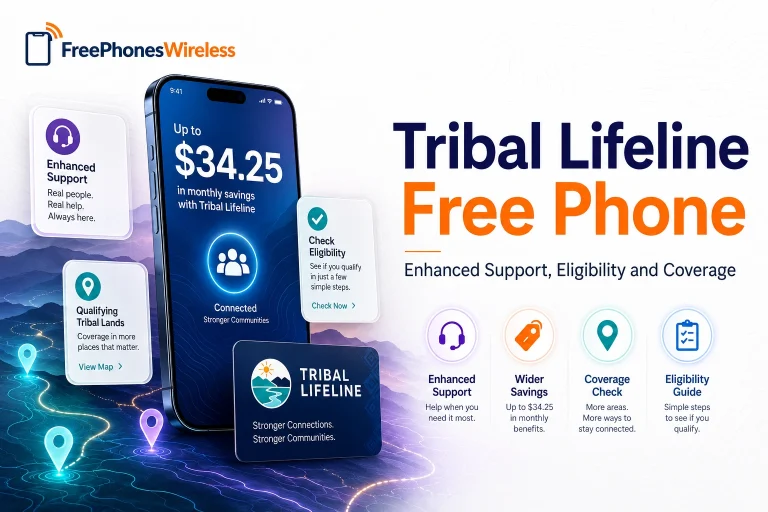
Eligible households on qualifying Tribal lands may receive up to $34.25 toward phone, internet, or bundled service.
Many “free government phone” plans combine voice and mobile broadband. That is why provider advertising may describe a no-cost wireless plan even though the government program is structured as a monthly service discount.
Who may qualify in 2026
Eligibility can come through income, an assistance program, or special survivor protections.
You do not need to meet every route. One valid route is enough, but the application may ask for records when eligibility cannot be confirmed automatically.
Income route
Your household income may qualify when it is at or below 135% of the applicable federal poverty guideline for your household size and location.
Program route
You, your child, or a dependent may qualify the household through participation in an approved assistance program.
2026 Lifeline income limits
These figures represent 135% of the 2026 Federal Poverty Guidelines. Use the column for the applicant’s state or territory.
| Household size | 48 states, D.C. and territories | Alaska | Hawaii |
|---|---|---|---|
| 1 person | $21,546 | $26,933 | $24,786 |
| 2 people | $29,214 | $36,518 | $33,602 |
| 3 people | $36,882 | $46,103 | $42,417 |
| 4 people | $44,550 | $55,688 | $51,233 |
| 5 people | $52,218 | $65,273 | $60,048 |
| 6 people | $59,886 | $74,858 | $68,864 |
| 7 people | $67,554 | $84,443 | $77,679 |
| 8 people | $75,222 | $94,028 | $86,495 |
| Each additional person | Add $7,668 | Add $9,585 | Add $8,816 |
Income documentation may include a prior-year tax return, current income statement, benefits statement, or recent consecutive pay records. Program documentation generally needs the participant’s name, program name, issuing agency, and a recent issue or future expiration date.
Additional path for survivors
Survivors of domestic violence, human trafficking, or related crimes may qualify for emergency Lifeline support under expanded financial-hardship rules after an attempted line-separation request. Additional routes can include income at or below 200% of the federal poverty guidelines, WIC, school lunch or breakfast participation, or a current-year Federal Pell Grant.
How to apply
Approval and phone enrollment happen in connected but separate steps.
A clean application starts with eligibility, then moves to the provider and plan. Oregon and Texas use their state application processes.
Confirm your qualification route.
Decide whether the household is applying through income, a qualifying program, Tribal eligibility, or the survivor benefit.
Apply through an official channel.
Apply online, by mail, or with help from a participating company. Start with the official Lifeline application instructions.
Respond to document requests.
Upload only the requested pages, make sure names and dates are visible, and avoid sending original documents by mail.
Compare participating providers.
Use coverage, data, hotspot terms, phone options, and support quality, not the headline alone. The official provider search tool can help identify companies in your area.
Enroll, activate, and save the records.
Keep approval information, provider confirmation, tracking details, plan terms, and activation instructions until the service is working.
What “free phone” means in practice
The plan is recurring. The device offer can change overnight.
Provider inventory is more fluid than Lifeline eligibility rules. A useful article separates stable program facts from temporary phone promotions.
A specific model is rarely guaranteed
Providers may ship from available inventory. Ask whether the phone is new or refurbished and whether the model shown in advertising is illustrative.
5G service and a 5G phone are different claims
Coverage, SIM provisioning, device bands, and plan access all matter. Read the Free 5G Government Phone guide before treating a network logo as a device guarantee.
An iPhone is usually not part of the standard promise
Premium models may appear as upgrades, refurbished stock, or limited promotions. Our Free Government iPhone guide explains the claims to verify.
BYOD may be the better value
An unlocked compatible phone can offer a familiar camera, storage level, accessibility setup, and app history without relying on entry-level provider inventory.
Provider research
Compare the offer available at your address, not a national promise.
These companies are among the wireless providers readers commonly evaluate. Availability and plan terms vary, so each guide focuses on what to check before applying.
TruConnect
Compare state plans, coverage, data, hotspot features, and phone or SIM options.
Provider guideLife Wireless
Review state-specific data, network claims, device routes, and ongoing account rules.
Provider guideSafeLink Wireless
Check ZIP-code offers, free phone or BYOP choices, number transfers, and support tools.
Provider guideAssurance Wireless
Examine the current plan, limited phone promotion, T-Mobile coverage, and BYOD route.
The provider with the most attractive phone is not automatically the best option. Confirm indoor and outdoor coverage, monthly high-speed data, hotspot limits, replacement costs, customer support, and whether service is offered at your exact address.
Before accepting an offer
Ask the questions that reveal the real cost of “free.”
A short verification checklist can prevent a weak network, unexpected charge, unsuitable phone, or application sent through an unrelated website.
Do not submit sensitive records to an unclear site.
The page should identify the provider or official program, explain why information is collected, provide privacy terms, and avoid pretending that ACP enrollment is still open.
What network will the plan use?
Check signal where the phone will actually be used, not only a broad national coverage statement.
How much high-speed data is included?
Ask what happens after the allowance is used and whether hotspot data shares the same limit.
What device route is offered?
Clarify whether you receive a phone, SIM, eSIM, BYOD option, or a paid upgrade.
Which charges are outside the benefit?
Review shipping, taxes, extra data, international use, accessories, upgrades, and replacement fees.
How are number transfers and replacements handled?
Understand the porting process and what happens when a phone is lost, stolen, damaged, or incompatible.
Lifeline is not the ACP
One program remains active. The other ended.
Confusing the two names can lead readers to outdated enrollment forms and misleading device claims.
The Affordable Connectivity Program stopped providing benefits after its funding ended. Lifeline continues under separate rules and has different benefit amounts, eligibility standards, and provider obligations. Read the ACP Free Phone article for a detailed explanation of outdated ACP offers.
After activation
Keeping Lifeline requires more than charging the phone.
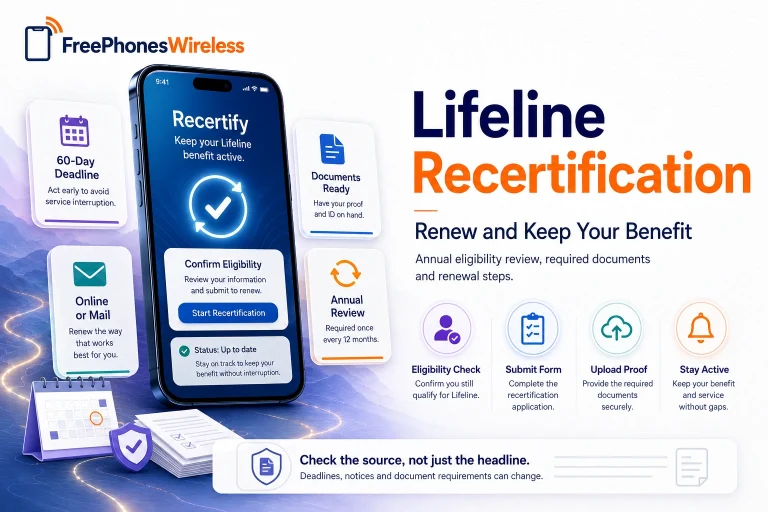
Service can end when a customer ignores recertification, stops qualifying, or leaves a free line unused. Provider notices should be treated as account deadlines.
Respond to recertification when requested
USAC or a state process checks eligibility each year. When a response is required, the notice generally provides 60 days to complete it.
Use free service at least every 30 days
For plans subject to the usage rule, inactivity can trigger a notice and a 15-day period to use the service before it may be disconnected.
Report when eligibility ends
If income rises above the limit or qualifying program participation ends, follow the program and provider instructions instead of continuing an ineligible benefit.
Lifeline free phone FAQ
Clear answers to the questions behind the search.
These answers separate federal Lifeline rules from provider-specific phone promotions.
Does Lifeline guarantee a free phone?
No. Lifeline guarantees an eligible service discount under program rules. A participating wireless provider may include a free phone, SIM, eSIM, or BYOD option, but the device is part of the provider’s offer.
How much is the Lifeline benefit?
Standard support can be up to $9.25 per month for qualifying broadband or bundled service and up to $5.25 for qualifying voice-only service. Eligible households on qualifying Tribal lands may receive up to $34.25.
Can two people at the same address receive Lifeline?
Possibly, when they form separate economic households and do not share income and expenses. They may need to complete the Lifeline Household Worksheet. Two members of the same economic household cannot each receive a benefit.
Can I choose the exact smartphone?
Usually not unless the provider’s offer explicitly guarantees the model. Inventory may include entry-level, refurbished, or substitute devices, and paid upgrades can be handled separately.
Can I switch Lifeline providers?
Yes. Contact the new participating company and ask it to transfer the benefit. The old provider’s benefit ends when the transfer is completed, because the household cannot keep two Lifeline discounts.
What documents might be requested?
The application may request proof of income, program participation, identity, address, or household status. Documents should show the required name, program or income information, issuing source, and acceptable date.
Is an ACP free phone still available?
No active ACP enrollment or benefit exists. The ACP ended on June 1, 2024. Current phone assistance claims should be evaluated under Lifeline, provider promotions, or another clearly identified program.
The practical conclusion
Qualify first. Compare service second. Treat the phone as the third decision.
That order keeps the article’s promise honest: Lifeline can make essential service affordable, while the device and plan must still be verified provider by provider.
Official references: Lifeline Support, eligibility and 2026 income guidelines, supporting documents, and FCC ACP advisory. Provider plans, inventory, and coverage can change.